Toward an Ending That Cannot Be Skipped ~ A Critique of the Ending Animation of the TV Anime 『Koi Kaze』 ~
The original text is in Korean, and this translation was produced by ChatGPT.
Japanese animation in the Reiwa era has become highly standardized in its composition. In short, it is now rare for there not to be a one-minute-and-thirty-second opening and ending animation, or for the main episode not to be divided into two parts. Even departures from the pattern, such as omitting the opening or ending in some episodes, have become clichés of their own. At the same time, the specific images that appear in opening and ending animations are commonly thought to be like this as well. If one searches YouTube and the like for “anime opening clichés,” “アニメOPあるある,” or “anime openings be like,” one can easily find videos parodying such images. In other words, viewers of Japanese animation treat its openings/endings as “obvious,” as videos that can be skipped without consequence. Yet at the same time, the opening and ending of Japanese animation are clearly sites of animated experiment ― places where great animators gather. The free overlapping of several layers of entirely unrelated images, or rhythm drawn through the motion of geometric figures, that is, so-called abstract animation, obtains its justification only there, in the place that occupies a special position in the world of Japanese animation. That special position lies somewhere between animation and visual design, between an independent music video and an opening/ending subordinated to a series.
https://youtu.be/TR3ma_60-m4
The opening animation of 『Steins;Gate』. It rapidly moves among images intentionally multiply exposed in several layers.
https://youtu.be/_AVvkDDFD34
The ending animation of 『Hidamari Sketch』. Geometric figures appear and move in time with the rhythm of the song, producing a visual prosody. In addition, it creates a rotating space by contrasting a rapidly moving layer of background images with a still character, and through the outline of a bird that reproduces the stair-stepping of a bitmap image, it gives the feeling that the object has been further enlarged.
The opening/ending of Japanese animation approaches us, on one side, as an assemblage of images that appear clichéd, and, on the other side, as a site of animated experiment. Yet why, despite constant experiment, are opening/ending animations treated poorly by viewers? Why do even those who criticize people who watch animation at faster playback speeds to save time skip the one-minute-and-thirty-second opening/ending animation?
To answer this question, I will make an analogy about what role opening/ending animations have played within animated series. Using that analogy as a foothold, my aim is to discuss in what sense the ending animation of 『Koi Kaze』 was able to become an “ending that cannot be skipped,” and how it reverses endings in general into “things that cannot be skipped.” Thus, I will not conduct a survey of the state of openings/endings and scold either the image or the viewer as the one at fault.
Opening/Ending Animation as a “Frame of Time”
In addition to the two opposed aspects described above, opening/ending animation has a practical purpose insofar as it is the opening and ending of a TV anime. Rather, this function is probably the fundamental material property of opening/ending animation. That is, it informs television viewers that the anime is about to begin, or that the anime has just ended and they can safely change the channel. Therefore, the opening catches the feet of those wandering across TV channels, gives ninety seconds of leeway to those who hurriedly turned on the television, and concentrates scattered gazes in one place. Conversely, the ending opens the hand that had held those gazes and lets them disperse.
Yet on the other side, the opening announces that the rain of commercials has stopped and the anime has just begun, while the ending announces that the anime will soon end and enter the commercials. In short, the opening/ending belongs not to commercials, not to fragmentary information on the screen, and not to the previous or next episode, but to that very episode of that anime; at the same time, within that anime itself, it is expelled outside the main body and reduced to a signal that notifies us of the beginning and end of the main body.
An opening/ending that is negated by the main body of animation and also negated by the external commercials is rather a frame. Especially, in the sense that, as seen above, the opening/ending has an asymmetry of the same form as time, it is a frame of time. The frame is “neither the work nor outside the work, neither inside nor outside, neither above nor below”1. In other words, the frame ― whether visible or invisible ― is an element internal to the work in relation to the external wall, and is external to the painting within it. At the same time, as a frame, it delimits the area of the picture it surrounds. The frame is precisely what, around a painting, produces the determination that makes it possible to call that painting numerically one. When not the painting but the frame draws the boundary of the painting, the boundary of the painting itself is not there. Without a relation to the frame, the painting cannot be delimited as that painting. Therefore, it is not that the frame needs the picture, but rather that the picture itself needs the frame. It is in this context that, in episodes 4, 6, and 9 of 『Hidamari Sketch ×365』, the ending and opening are additionally inserted between the temporally separated A and B parts instead of an eyecatch. Here, the ending and opening are signs that establish the boundaries of each part. They cut the connection between the A part and B part, which might in some sense be called a montage, and make each part into an independent “episode.”
But at this point the painting extends in the direction of the frame. When the painting, unable to delimit its own boundary by itself, calls for a frame, the frame artificially determines the picture as one object and at the same time becomes an inseparable one together with the picture. Thus the boundary of the painting inside the frame scatters as the painting demands that the frame participate in the picture. Or, the contour of the painting indicated by the frame is sucked into the picture together with the frame as that very frame supplements the painting. Now the frame, within the picture, draws what the painting could not draw, and thereby produces a new meaning for that painting. As an “extended region of signification”2. The first unskippable opening/ending will become possible in this sense.
Preparatory Work ─ On the TV Anime 『Koi Kaze』
Before discussing the ending animation of 『Koi Kaze』, I will first examine the criticism of 『Koi Kaze』 by the independent critic 異邦人 (Ibangin), “A Comparison of the Anime Koi Kaze (恋風) and the Manga Koi Kaze”3. He also wrote five other amateur but meticulous essays on the manga 『Koi Kaze』. Perhaps this entire project may be read as a metacriticism of Ibangin.
For Ibangin, the manga 『Koi Kaze』 is filled with symbolic signs. For Ibangin, cherry blossoms are the beginning and end of 『Koi Kaze』, the growth between them, the place where Koshiro confesses his feelings, and the place of healing for Koshiro and Nanoka. At the center of all these cherry blossoms there is always Nanoka. For him, Nanoka is the cherry blossom, that is, transcendent flawlessness and pure femininity. For Ibangin, Koshiro is the figure who meets Nanoka as cherry blossom and calls to mind sincere and tender feelings. Therefore, for him, the cherry blossom cannot help but become the center of the meaning of 『Koi Kaze』. The three springs in which cherry blossoms bloom in 『Koi Kaze』 are changes or developments in Koshiro’s feelings. Ibangin argues that the three springs respectively signify the developmental stages of a beginning as simple recognition, separation and violent emotion, and the vow of eternal love, that is, beginning, end, and completion. The second summer that heads toward completion, Koshiro and Nanoka’s trip to the enmusubi shrine and the summer sea at sunrise, becomes for Ibangin precisely the device that suggests that the two people’s feelings continue into the next life. For him, 『Koi Kaze』 is a manga that depicts the process in which a man is healed and grows ― in the Nietzschean sense ― within his relationship to cherry blossoms and Nanoka, and in which the transcendent and eternal feelings of the two are completed4.
Yet in Ibangin’s essay on the anime 『Koi Kaze』, “A Comparison of the Anime Koi Kaze (恋風) and the Manga Koi Kaze,” he was naive in at least two directions. First, Ibangin chose to read the anime 『Koi Kaze』 by comparing it to the manga 『Koi Kaze』. As Ibangin did, evaluations directed at anime often do not face the anime. Rather, the evaluation faces the “original work” placed in a privileged position. There, the anime “transcends” or “destroys” the original, but there is no hermeneutics for the anime. In short, whether the anime has “transcended” or “destroyed” the original, insofar as the claim is merely that it supplements or escapes from the already-revealed aesthetic statement of the original, no new meaning for the anime text will be produced. At this point, the anime becomes merely a supplement added to the original. Especially when an element of the original is absent from the anime ― for example, since a pair of shoes depicted in Van Gogh’s painting may in fact be “two shoes each with a different mate, two shoes from the same side, or one shoe and its ghost”5, that element can always be one symbol ― the situation leaves the anime as something lacking (that symbol), something that has lost meaning, and therefore as incomplete. Thus, under so-called original-work centrism, the anime, because it can never reproduce the meaning of the original, not only cannot give birth to new thought but becomes a frame outside the original. When Azuma Kiyohiko wrote on his blog, “…explaining why I do not make it into an anime somehow feels like acknowledging the idea that manga is the ‘original work’ of anime, so as a manga artist I do not want to do it”6, he was rather expressing dissatisfaction with original-work centrism. For the moment when a manga becomes the original work of an anime, that is, when manga comes to bear the name “original work,” is the moment when one reads the anime with that manga at the center.
Therefore, when Ibangin thought that Koshiro is completed only through the three cherry blossoms and springs, and when he dogmatically took that as the truth meant by 『Koi Kaze』, he was already unable to tolerate any change the anime might make to 『Koi Kaze』. Thus, the anime 『Koi Kaze』, which metaphorizes Nanoka not as cherry blossoms but as muddy water, and which deletes the shrine trip and sunrise of the second summer, could only be understood by Ibangin as having castrated the purity and transcendence of the manga 『Koi Kaze』. When Ibangin wrote that Koshiro in episode 8 of the anime 『Koi Kaze』 “does not drink the muddy water and throws it away,” it was because, for him, the muddy water symbolized a difference from the original that was nothing but a superfluous appendage. Therefore, the muddy water had to be thrown away. Forgotten is the sequence that crosscuts the scene where the young Koshiro does not throw away the muddy water and keeps delaying throwing it away with the figure of Koshiro returning home and recalling this memory as if amused.
The other direction is that, when this meticulous critic read 『Koi Kaze』 as anime, he decided to skip the opening and ending ― the most animated elements.
The Ending Animation of 『Koi Kaze』 as an Unskippable Ending
The ending animation of 『Koi Kaze』7 is simple. The first ending one encounters, around the time episode 1 ends after beginning 『Koi Kaze』, is even bewildering. The outlines of three people walking leisurely along a sandy beach are shown, waves come in, … and that is all. We cannot know when or where the sea where the three are walking is; we cannot even know who the three people are.
https://youtu.be/kxnG9dawYcg
The ending animation of 『Koi Kaze』. From episode 1 to episode 8, the ending consists entirely of a scene in which three people walk along the seashore.
They walk on a single layer. The backlight of the sun shining from behind them (sunrise? or sunset?) removes their thickness. No, it is even questionable whether they are really walking forward. Only the waves, pushing out of the screen toward the slightly leftward direction, indicate that they are walking forward. In reality, only the camera ― if there is anything that can be called a camera in animation ― is facing little by little toward the front of the direction in which they walk. On the other hand, the deliberately designed colors and the peculiar forms of the clouds and waves seem to separate the main episode from the ending. The ending of 『Koi Kaze』 is an empty ending, composed of anonymous time-space, anonymous figures, and ambiguous directionality, and separated off.
Here, the ending animation of 『Koi Kaze』 functions as though forming an opposed pair with 『Koi Kaze』. Whether one likes it or not, 『Koi Kaze』 is problematic… yet it still seems to be composed in a classical, non-experimental manner. In the scene where Koshiro and Nanoka first meet, 『Koi Kaze』 alternately places close-ups of Nanoka and Koshiro, while inserting cherry blossoms in a direction that passes through this cut. Nanoka’s impression passes through the cherry blossoms, and even after Koshiro is left alone, it makes one imagine the other side of the screen indicated by Koshiro’s gaze. Whether in the manga 『Koi Kaze』 or the anime 『Koi Kaze』, the reader will discover the impression of metaphor within it, and this discovery itself is immanent to 『Koi Kaze』. In this sense, Ibangin is a faithful reader of 『Koi Kaze』, and the metaphor he revealed in 『Koi Kaze』 is also a simile. Yet the anime 『Koi Kaze』, as discussed above, is extended in the direction of the ending. At the same time, the ending animation of 『Koi Kaze』 as an empty ending halts this discovery of figuration and delays it for one minute and thirty seconds. The extended region of signification is emptied out, and thus one hole is opened somewhere in 『Koi Kaze』, which is filled with symbols. As though all the signs of 『Koi Kaze』 break together with the waves, one of the protagonists of the ending ― for what can be seen there are only waves and figures.
Let us note that this operates in parallel upon the manga and the anime 『Koi Kaze』. Then the ending animation of 『Koi Kaze』 is also the sublation of original-work centrism itself. When, under original-work centrism, the anime 『Koi Kaze』 becomes the supplement of the original, the ending of 『Koi Kaze』 stops the signification continuing from the original. Then it inserts there the virus of a one-minute-and-thirty-second empty space. At this moment, the anime 『Koi Kaze』 conversely changes the meaning of the original. Original-work centrism applied to 『Koi Kaze』 comes, at this point, to negate itself.
Yet 『Koi Kaze』 does not stop here. When Nanoka confesses her love to Koshiro, the ending animation of 『Koi Kaze』 changes: a short close-up is added, of one part of the sea where a sand shovel drifts away, where the sandcastle made with that shovel has not left even a trace. Since the sandcastle and shovel are entirely new objects, that place is another place of the sea, and thus this insertion looks somewhat random. Yet the sameness of the sea guaranteed by the connection between the two scenes, and the trace of the sandcastle close-up in the added scene, indirectly present a small narrative. The three people in the ending, no, the four people ― the intimate relation between 『Koi Kaze』 and its ending demands that the figures in the ending be the protagonists of 『Koi Kaze』. One episode before the ending changes, Koshiro’s recollection reveals that the young Koshiro and Nanoka are in the ending. At the same time, the ending repeated steadily from the first episode conversely grants legitimacy to that flashback. Without presenting any marker in the ending, the change in 『Koi Kaze』 suggests who those figures are. ― had been playing together at the sea, making a sandcastle, and are now returning home as the sun sets. The sandcastle left behind collapses, washed away by the waves together with the shovel.
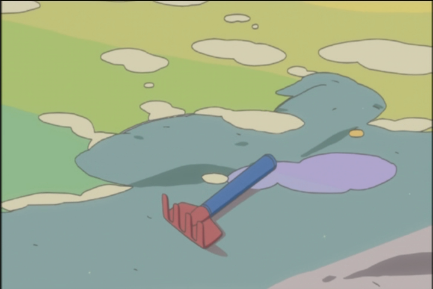
A scene from the last cut of the ending animation from episode 9 of 『Koi Kaze』 to the final episode.
Nanoka’s confession fails because of Koshiro’s conscious reaction against incestuous romance. Nanoka tries to run out of the room, but in that short interval Koshiro grabs Nanoka’s arm and embraces her. Nanoka shakes Koshiro off and leaves the room. At this moment the two clearly conveyed feelings that were trying to connect. Yet these feelings do not reach the one they should reach. And the ending begins. And…. Thus 『Koi Kaze』 creates a strange connection between this undelivered confession and the trace of the sandcastle.
In the next episode, Koshiro does not meet Nanoka, who left home early in the morning. In order to discard the embrace-of-Nanoka that did not arrive, Koshiro resolves to leave home. The screen then shows Nanoka worrying between the failed confession and the questionable embrace, then Koshiro looking for a place to live, then Nanoka going to a friend’s house because she does not want to go home. A little later, when Koshiro returns home and tries to tell his father that he will leave the house, the phone rings. In this call from Nanoka, Koshiro and Nanoka realize together that there had been some delivery error in that confession which did not arrive. Nanoka returns home earlier than planned. Yet Koshiro’s contract for the new house is fixed. The two come to be together, but the confession that had failed to arrive does not arrive again. Yet: “There was something I couldn’t keep saying. Do you remember? When we were on the Ferris wheel. (…) Back then, I was really happy. So if things went on like this, I…” Koshiro and Nanoka hold hands. Clearly, through the connected phone and connected hands, the confession that had failed to arrive has changed. But because of the two people’s different definitions of siblings8, the success of the confession is delayed and the delivery error is repeated.
In the morning, Nanoka wakes alone. The ending begins entwined with Koshiro packing his belongings and opening the door, and with the pouring sunlight. The ending begins with traces of a sandcastle different from the previous one. The sandcastle still retains a certain degree of form, and the sand shovel is stuck in the sand. Still, the waves wash away the sandcastle. It appears closer to an intact sandcastle, but still is not a sandcastle. 『Koi Kaze』 continues subtly to connect failed-to-arrive confessions and traces of sandcastles.
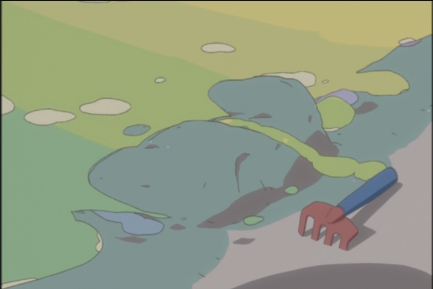
A scene from the last cut of the ending animation from episode 10 of 『Koi Kaze』 to the final episode.
At the same time, this ending directly reveals the figures in the ending, who had until now been explicitly hidden. The young Koshiro and his mother, and the father holding Nanoka. This revealed fact no longer seems very surprising, but on the other hand, something still remains unrevealed. Are the four truly together, especially the mother-Koshiro pair and the father-Nanoka pair? In the second cut of the ending, which shows three people walking together, they are still anonymous. Conversely, from the third to the sixth cut, even though they are explicit, they are not together. They are connected only by gazes. Rather, the ending places the divorced mother and father, and Koshiro and Nanoka, as opposed pairs.
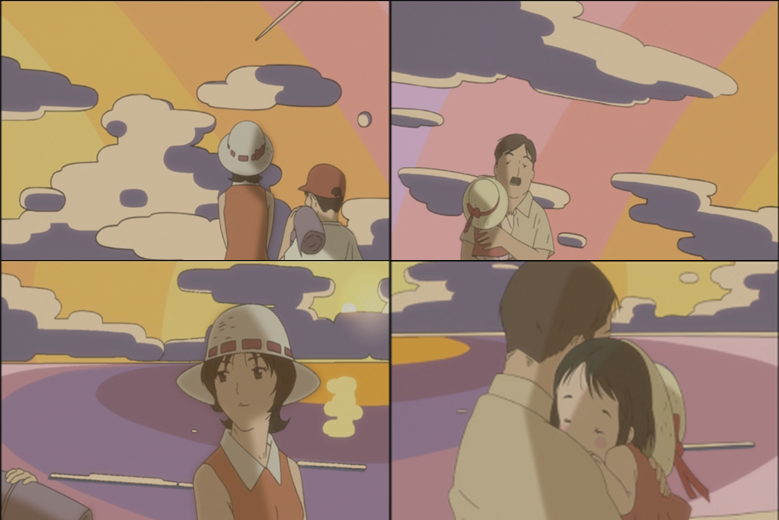
Scenes from the third cut to the sixth cut of the ending from episode 10 of 『Koi Kaze』 to the final episode 9.
Without resolving the opposition, the ending shows again the trace of the first sandcastle. Koshiro and Nanoka still do not reach each other. The subtle connection seen above has now become deeply immanent to the ending.
Koshiro moves out, and Nanoka secretly leaves a handmade sweater in front of the door of Koshiro’s house. Since Koshiro, who happened to see this, tried to hide together with his coworker Chidori, Chidori discovers Koshiro’s feelings for Nanoka. Chidori despises Koshiro, and Koshiro shuts himself in his room and becomes a wreck. Koshiro, unable to do this or that, is about to go out to buy tissues when he meets Nanoka, who has secretly come to his house to deliver oranges. And… through various things… the two spend the night together (ending), travel to their mother’s house, and even think of a double suicide at a pier where entry is prohibited…. On the other hand, Nanoka’s friends sense that Nanoka has a boyfriend, but because it “somehow scares” them, they stop confirming it. Koshiro, who has quit the company, looks at the nameplate bearing Saeki Genzo, Kojiro, and Kohinata Nanoka, and apologizes. And above all, he announces that the amusement park that has special meaning for Nanoka and Koshiro will disappear because of their father’s company.
Koshiro and Nanoka return once more to the amusement park where a notice of closure has been posted. At the amusement park, Koshiro and Nanoka play on the sandy shore and get covered in mud. When Nanoka goes to wash, a girl hands Koshiro muddy water into which cherry blossoms have fallen. Koshiro thanks her and drinks it. Clearly at this moment, Nanoka’s muddy water, which the young Koshiro had kept delaying drinking, has reached Koshiro. Koshiro and Nanoka have become lovers who have joined bodies, and the success of the confession that had been delayed has been achieved. The confession that had failed to arrive seems to have arrived at each other. Yet 『Koi Kaze』 continues.
In the closed amusement park at night, Koshiro and Nanoka ride once more on the stopped Ferris wheel. The Ferris wheel does not operate. Yet when the two pray, the Ferris wheel moves once, just once. Day breaks, and when the amusement park opens, the two leave it. On a tree in the amusement park that will one day disappear, they draw an ai-ai-gasa and promise to come back every spring. Looking at Nanoka’s back as she walks ahead, Koshiro quietly says, “I love you.” His shy confession will not reach Nanoka. The promise toward the two’s eternal future will not be kept. Then the final ending of 『Koi Kaze』 begins.
The trace of the sandcastle, in which the ending has been absorbed until now, has kept slipping since the moment Nanoka’s confession and Koshiro’s answer failed to reach each other. Whenever 『Koi Kaze』 comes to an end, it has continued to call up the trace of the sandcastle. Yet that trace is not fixed at the moment of the failed confession. ― The ending of 『Koi Kaze』 changes twice, that is, has three aspects. It is obvious that these three endings differ from Ibangin’s three springs, but at least his claim that the anime 『Koi Kaze』 has only two springs and therefore its meaning is one-off and futile is negated in this context. ― When the language exchanged between Nanoka and Koshiro repeatedly fails to be received, or when others could not welcome them, the trace of the sandcastle that penetrates 『Koi Kaze』 appears. Not all of those traces are the same. They are the muddy water, Nanoka’s confession, Koshiro’s contract, Nanoka’s crumpled letter, the fact that the friends stopped learning about Nanoka’s boyfriend, and the ai-ai-gasa drawn on the tree, as a space in which all these things accumulate. Therefore, the ending of 『Koi Kaze』 changes endlessly.
Within 『Koi Kaze』, Koshiro and Nanoka seem to be overcoming the trace of the sandcastle. Despite the failed confession, the two become lovers, and despite Koshiro’s contract, the two come to live together. Yet 『Koi Kaze』 still continues to present failures of communication: with Nanoka’s friends, Chidori, and the father; and things that cannot be delivered: the ai-ai-gasa, Koshiro’s confession. And perhaps 『Koi Kaze』 writes that the reception failure which seemed to have been overcome has in fact not been overcome, that the muddy water Koshiro drank is different from the muddy water Nanoka handed him, and therefore that nothing has been resolved. 『Koi Kaze』 will continue, and the ending of 『Koi Kaze』 will repeat endlessly.
Nevertheless, Nanoka and Koshiro will not stop trying to communicate. Just as they kept revising and newly writing and sending the confession that had failed, just as Nanoka asked why siblings must not love each other and then said, “I won’t give up.” Even if this leads to another reception failure and a changed new ending begins, 『Koi Kaze』 is never interrupted. As Koshiro says, “There are other people we need to apologize to,” and therefore the two will not stop relating to other people either. The ending animation of 『Koi Kaze』, which changes subtly and secretly while being called up without end, is precisely what guarantees this.
Now I have “landed in the same place, though the conclusion may differ,” as Ibangin did. The permanence guaranteed by the ending of 『Koi Kaze』, the permanence in which Koshiro and Nanoka constantly challenge impossible communication, is nothing other than Ibangin’s “heroic act for proving life.” With this, it seems clear that Ibangin skipped the ending of 『Koi Kaze』.
Closing ─ “Unskippability” as an Epidemic
The ending of 『Koi Kaze』 seems to operate only within the instance of a single anime called 『Koi Kaze』. Yet since this criticism is a metacriticism, there is a secretly hidden trace of a sandcastle inside this criticism. It is Ibangin’s writing as read by me. And it is my command, delivered to him, not to skip the ending of 『Koi Kaze』: a command that will not be delivered. This trace circles inside me just as the ending of 『Koi Kaze』 did in the direction of 『Koi Kaze』. Through this written criticism, the trace of the sandcastle has also come to extend in my direction.
Now I cannot skip the ending of any anime. When the criticism I wrote of the ending of 『Koi Kaze』, the trace of the sandcastle, comes to me while I watch another anime and begins to operate, I am seized by the fear that that anime and its ending may be Koi-Kaze-like. And perhaps also when I watch the opening, the other direction of the frame.
And hopefully, also in the direction of the reader of this essay,
-
Derrida, J. The Truth in Painting (Geoffrey Bennington & Ian McLeod, Trans.), page 9. University of Chicago Press, Chicago, 1987. ↩
-
Kim Ho-young. The Rhetoric of the Frame, p. 39. Munhakdongne, Gyeonggi, 2022. ↩
-
It is a little embarrassing to discuss 『Koi Kaze』 first in order to discuss its ending animation. Yet since that ending animation is, as will be confirmed in the next section, an unskippable ending, and since 『Koi Kaze』 was a manga/anime that received little attention, at least in Korea, I hope the reader will understand that the description of 『Koi Kaze』 within this criticism is unavoidable. And on the other hand, for precisely that reason, this essay is also a criticism of 『Koi Kaze』. ↩
-
For Ibangin’s discussion of 『Koi Kaze』, see the following six essays. All accessed February 29, 2024.
異邦人, 연풍(恋風)ㅡ 그 남자의 마음의 자각과 구원, 異邦人のTISTORY, May 12, 2016. https://earthdreamer.tistory.com/2.
───, 연풍(恋風)-나노카의 상징성과 영원한 맹세(1), 異邦人のTISTORY, June 23, 2016. https://earthdreamer.tistory.com/23.
───, 연풍(恋風)-나노카의 상징성과 영원한 맹세(2)-1, 異邦人のTISTORY, July 2, 2016. https://earthdreamer.tistory.com/25.
───, 연풍(恋風)-나노카의 상징성과 영원한 맹세(2)-2, 異邦人のTISTORY, July 11, 2016. https://earthdreamer.tistory.com/30.
───, 만화 연풍(恋風)의 상징성 -벚꽃과 바람을 중심으로-, 異邦人のTISTORY, November 16, 2016. https://earthdreamer.tistory.com/50.
───, 애니 연풍(恋風)과 만화 연풍과의 비교, 異邦人のTISTORY, January 17, 2017. https://earthdreamer.tistory.com/60. ↩ -
Kang Woo-sung. The Logic of the Parergon: Derrida and Art. The English Language and Literature Association of Korea, (14):5-34, 2008. ↩
-
Azuma Kiyohiko. あずまきよひこ.com» Blog Archive» よつばとアニメ, web.archive.org, Feb. 23, 2014. https://web.archive.org/web/20140223002337/http://azumakiyohiko.com:80/archives/2008/12/05_093234.php, Accessed: Feb. 29, 2024. ↩
-
Storyboard and direction: Omori Takahiro (大森貴弘), animation: Kishida Takahiro (岸田隆宏) ↩
-
Nanoka’s definition is revised by Koshiro, but it is still separated to a certain degree from social norms. Paying attention to this fact, one might think that lolicon anime was invented from the anime 『Koi Kaze』. However, since 『Koi Kaze』 is still not lolicon, but a story about siblings, one cannot say that it constituted a pure lolicon anime. A discussion of this is distant from the topic of this essay, so I omit it. ↩
-
How far the delicacy of wrinkles in everyday acting animation of figures with simple character designs can go is shown clearly in these cuts drawn by Kishida Takahiro. ↩