JC Becomes the Spirit of the Age ~ An Introduction and Critique of the TV Anime 『Onimai: I’m Now Your Sister!』 ~
The original text is in Korean, and this translation was produced by ChatGPT.
Just as the SF mecha and moe of 『Neon Genesis Evangelion』 and the fighting bishōjo of 『Saikano』 were, 『Onimai: I’m Now Your Sister!』 is the romance of the “otaku degenerates” of our age. Yet when one tries to explain this hazy romance, the questions raised by 『Onimai』 are three-dimensional. This is because 『Onimai』 constantly oscillates among nichijou-kei, lolicon anime, and TSF, and the images it produces are not bound to any one of them. 『Onimai』 constantly makes the viewer participate. At the same time, as elements of each genre become entangled, the romance germinates by itself inside the viewer. By tracing the anti-growth path of the protagonist Oyama Mahiro, I will try to uncover the spirits of the age concealed in the TV anime 『Onimai』.
Introduction
It is clear that the TV anime 『Onimai』, which aired in the first quarter of this year, caused a huge ― and hard-to-identify ― response from its very beginning. Perhaps this was because the eroticism of loli and TS, tabooed as the domain of erotic manga, invaded the public sphere; or perhaps it was thanks to the “sakuga aesthetics boom” produced by 『Bocchi the Rock!』, 『Chainsaw Man』, and other works that had just finished airing. Yet the topicality and success of 『Onimai』, which slips away both from the grammar of nichijou-kei and from that of Japanese TSFTrans–Sexual Fiction, must in itself have some historical meaning.
『Onimai』 as an “Extraordinary” Nichijou-kei Anime
In nichijou-kei manga and anime, eros is completely castrated despite the formal structure of their cast. Men are completely excluded from the space of bishōjo, and readers merely contemplate the lives of the characters as a gaze. Even the common service scene is, in most cases, depicted flatly. As Nagayama Kaoru describes Barasui’s nichijou-kei manga 『Strawberry Marshmallow』 in Ero-Manga Studies as a “state in which desire and impulse are stopped” and as “concealed and unconscious eros,” this should paradoxically be understood as a perverse commodity 1.
Yet in 『Onimai』, sexual desire is displayed without restraint, as is already apparent from the blatant close-ups in the opening and the depiction of water running over the school swimsuit. Moreover, the long bath scenes in episodes 2 and 8 may be called experiments at the limit of eroticism in TV anime. Bath scenes frequently appear even in nichijou-kei anime such as 『Hidamari Sketch』, but they do not insist this much on the friction between skin wet with liquid and on acting animation inside the bath steam2. The bath scene in nichijou-kei is, on the surface, literally only the depiction of an “ordinary act of bathing,” and explicit eros does not appear. The wildly shaking, realist “sakuga-image” of 『Onimai』 revealed the eroticism of animation as such.
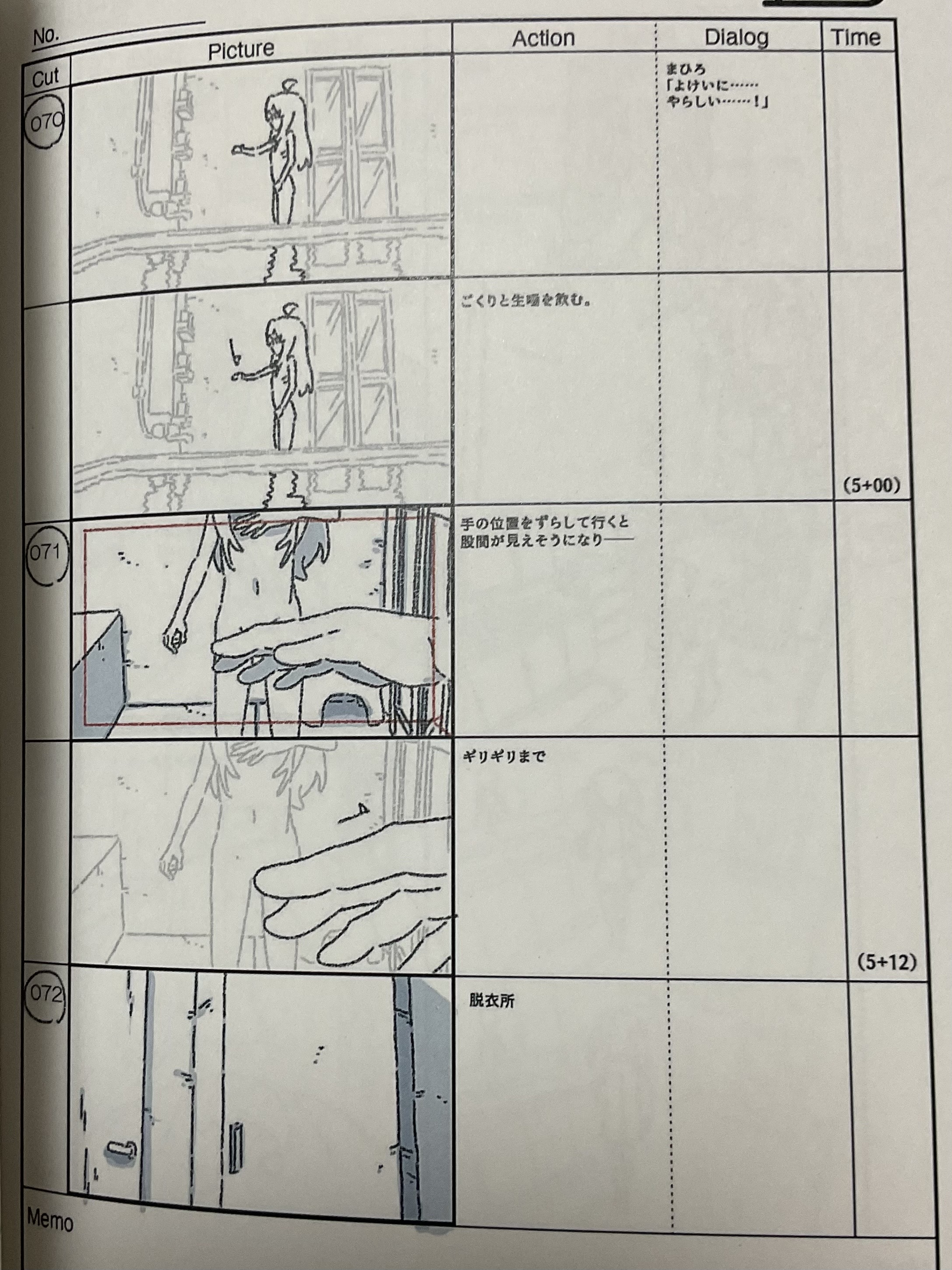
A scene from the storyboard of 『Onimai』 episode 1. Mahiro’s nude-image is visually severed by the hand. The realistic animation of this shot bears the dissolution of that severance.
Here, 『Onimai』 deviates from the nichijou-kei genre. Yet this is not an escape from genre. It is rather an opening-up of the desire hidden within the genre. In other words, the erotic images of R-18 yuri fanfiction devoured by refugees from nichijou works have moved into the surface layer ― TV anime. That is, 『Onimai』 is the projection of the “extraordinary” desire of the nichijou-refugee viewer into nichijou-kei anime.
『Onimai』 as Lolicon Anime
Elements born in erotic manga or derivative works often spread into the “sunlit” sphere, but what happened in 『Onimai』 ― precisely because 『Onimai』 is a TV anime ― requires another genealogical interpretation. This concerns how erotic depictions of loli, tabooed since the early 1990s, could appear in the medium closest to the public: TV anime.
As with 『Kodomo no Jikan』, the first bishōjo anime to depict loli eroticism, TV lolicon anime ― though there are not many of them ― has tried to contain certain ideas while observing the relationship between children and adults. 『Kodomo no Jikan』 accused the boyishness of adults and the youthfulness of children revealed in that relationship3, 『Today in Class 5-2』 revealed the maturity of children through a symbolic gekiga style, and by 『Fate/kaleid liner Prisma☆Illya』 it had come to praise the “loli” as a being superior to adults. Does this detour appear out of guilt about undressing children, or fear of the public’s hostile gaze? In any case, TV anime that depict loli sexuality have explicitly fled, from within themselves, from being “pleasure devices.”
By contrast, 『Onimai』 offers no excuse for depicting the naked body of a middle-school girl. The scene in which Mahiro and Mihari take off their tops, wash their hair, enter the bath, and get out is depicted only within the grammar of nichijou-kei, “whose contents one forgets after watching.” This meaninglessness is maximized in the blatant eyecatch drawn with realistic acting animation.
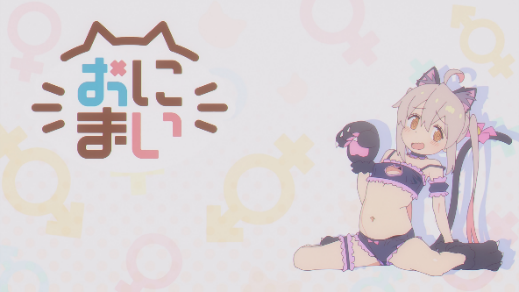
The eyecatch of 『Onimai』 episode 2. It depicts Mahiro in a perverse outfit that does not appear in the main episode.
Above all, there is probably no viewer who can read an absolute lesson from the scene in the latter half of episode 12, where Mahiro feels that it has been a long time since she had a snowball fight with friends and chooses to remain a loli. Instead, only the peculiar gap between the “Big Brother Remodeling Project” and the deliberately romanticized “remaining a loli” makes possible the viewer’s creation of meaning.
Nichijou-kei–TSF and the “Big Brother Remodeling Project”
In the end, the question of 『Onimai』 is traced back to the “Big Brother Remodeling Project.” According to Nagayama Kaoru, “cases in which the transsexual subject directly chooses a female body are very rare; in most cases, the transformation is a forced sex change through violence or threats, […] or else it occurs through deception.4” In short, causing a sex change in order to treat a hikikomori is not something that happens in ordinary TSF. At this point, 『Onimai』 even feels like “biotechnology SF.”
The problem of hikikomori is often handled together with otaku, and is even more often analogized and identified with them. As depicted in the latter half of episode 1, the protagonist Oyama Mahiro, “a solitary home security guard who loves eroge,” became a hikikomori due to the pressure of being the older brother of a genius younger sister and so on. To that extent, he is designed so that male otaku living in the present can strongly identify with him.
Meanwhile, Mahiro under the Big Brother Remodeling Project follows the structure of TSF, as each episode title indicates. Here the male viewer’s gaze identifies with the protagonist, while at the same time the protagonist undergoes experiences as a woman. 『Onimai』 deepens this point through the grammar of nichijou-kei. After 『K-On!』, at least by the late 2010s, one task of many nichijou-kei works was to “add one line to the reader’s bucket list”5. The context in which 『Onimai』 depicts the becoming-girl of a hikikomori lies here as well.
“[…] But actually, right now I feel strangely at ease. It feels like I’ve returned to a position that suits my station. Now I might as well let big brother be over and stay like this…” Mahiro’s degradation (being-absorbed), which begins from this monologue in the latter half of episode 1 as he recalls himself becoming a hikikomori, continues along a nichijou-kei path: buying a bra, learning how to wash long hair, having trouble holding in urine, and so forth6. While the otaku viewer re-experiences this degradation (being-absorbed) along a nichijou-kei path, the romance of 『Onimai』, symbolized by “I too want to become a loli,” finally occurs (just as 『K-On!』 did).
In the final episode, during a hot-spring trip with everyone, the effects of the “medicine that turns one into a girl” suddenly wear off and Mahiro begins to return to his original form. To prevent a disaster, Mihari offers him an extra dose, but if he takes it, he will not be able to return to his original form again for some time. In the either-or situation of adult and child, Mahiro chooses by himself to remain a loli. At the same time, when Mahiro, called as a loli, smiles and runs into the arms of his friends, Mahiro as an adult hikikomori, called by no one, is thoroughly sublimated. In that close-up, when the light effect softly illuminating just above Mahiro and the delicate animation drawn by mixing 3s and 2s romanticize the whole scene, the re-experience of sublimation erases even the viewer as hikikomori at that instant. On the snowfield, only children remain, laughing and playing.
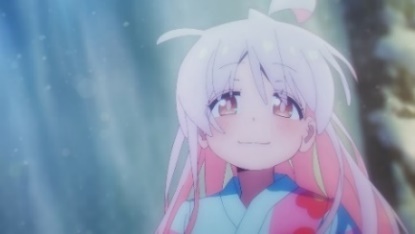
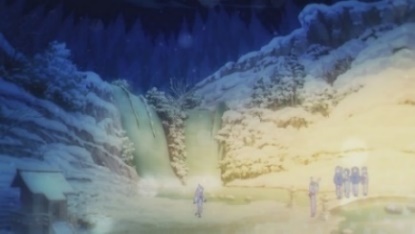
A scene from 『Onimai』 episode 12.
The Anti-Growth of the Hikikomori and Lolicon Anime
Thus, at the end of 『Onimai』, Mahiro does not become a splendid older brother. Rather, he refuses by himself to mature. In the train heading toward Oonimai Station (逢二妹駅), Mahiro and the viewer head toward anti-growth.
Anti-growth is not the opposite of growth, but the refusal of a work to become a “growth story.” Any concept opposed to growth, in any form, cannot help but accompany the metaphysics of growth. But within anti-growth, the structure of the growth story ― in which boyishness leaps into youthfulness by crossing a symbolized rite of passage through a certain effort ― is dismantled, and the protagonist is liberated from the binary opposition of boyishness/youthfulness, and from the myth called “growth” that urges one to become an adult. In short, TV lolicon anime, in which children and adults become entangled, should be read precisely as anti-growth narrative. 『Onimai』 as lolicon anime also depicts anti-growth by dismantling the binary opposition between Mahiro’s “inside,” which has become adult, and Mahiro’s “outside,” which has become a loli. The hikikomori has the boyishness symbolized by “the younger sister’s toy,” and the loli has adulthood, as Mihari proudly says, “Maybe the Big Brother Remodeling Project has produced results beyond expectations~.” But within the generic properties of nichijou-kei, the “Big Brother Remodeling Project” is neither immediate nor discrete. No one urges Mahiro to grow. There, Mahiro is remodeled without even knowing it.
Not as much as Mahiro, who nearly became an adult in the hot spring, but the moment of becoming an adult is sudden for everyone. We, who have become adults without any preparation, still wander and tremble with anxiety inside our respective societies while retaining boyishness. The hikikomori youth, a shut-in with anxiety disorder, likely arises within this context. To those who do not even possess everydayness, if one says that they only truly exist after overcoming anxiety or pain and urges them to go outside, would it not sound merely like the nonsense of some “boomer”?
Conversely, 『Onimai』 coaxes the hikikomori viewer through an experience of anti-growth together with the romance of our age’s otaku degenerates. In short, the fact that Mahiro, who had only ever been dragged around everywhere, chooses by himself to remain a loli as “the success of the Big Brother Remodeling Project” is a praise of moving away from anxiety and falling into the world of nichijou-kei. This depiction suggests that existential philosophy, or the model of the subject, can no longer diagnose the modern problem represented by the hikikomori.
What alienated people born on the far side of war ideology need is not a decision to escape everydayness and head toward the hero. Instead, what must be demanded is a new existential philosophy that tries to recover the lost everydayness, the excavation of the form of authentic existence entangled within everydayness. This work is now not philosophy, but rather takes place in the domain of popular culture; and 『Onimai』, which throws off clothes and “loli-fies,” has taken the first step together with the viewers who identified with it.
“I am, we are, Mahiro-chan” (俺が、俺たちがまひろちゃんだ)7.
In Place of a Conclusion
The products of otaku culture that become the subject of criticism ― not research ― are diverse, but “animation criticism,” especially in our country, seems in most cases to remain at the level of “animated film.” In other words, animation criticism functions as film criticism, not as criticism of otaku anime. Thanks to this, while the detailed depiction of meals through colorful shots in 『Your Name.』 drew attention, Okiura Hiroyuki’s realist acting animation that breathes life into running, or Hashimoto Takashi’s splendid explosion-effect animation, were forgotten.
As several recently released films show, interest in Japanese animation in our country is increasing. Whether or not as moving painting, I hope that animation criticism independent from film criticism, using the terms of animation, for otaku, becomes richer from now on, and that a space for it forms.
-
Nagayama Kaoru. Ero-Manga Studies (Seon Jeong-woo, Trans.), 334-338. AK Communications. 2022. ↩
-
Acting animation of nichijou-kei anime characters began to receive attention again at least after 『Yama no Susume Third Season』. This tendency continued afterward in 『Bocchi the Rock!』, 『Yama no Susume Next Summit』, 『Do It Yourself!!』, and others, leaving a small but definite trace. Among them, the commercial successes recorded by 『Bocchi the Rock!』 and 『Onimai』 were enough to change the terrain of nichijou-kei anime. Despite the analogy, I believe that “nichijou-kei sakuga anime” will become a new horizon for nichijou-kei anime. ↩
-
『Kodomo no Jikan』 is clever. The conflict depicted among an elementary-school teacher, elementary-school students, and guardians is, at a glance, erotic, but at the same time socially accusatory and didactic. I have therefore read 『Kodomo no Jikan』 as a work that dismantles the adult-child dichotomy presupposed by growth stories in general. This is why 『Kodomo no Jikan』 was able, as a TV anime, to depict loli eroticism for the first time. All lolicon anime aired after the success of the 『Kodomo no Jikan』 experiment probably owe a certain debt to it. ↩
-
Nagayama Kaoru. Ero-Manga Studies (Seon Jeong-woo, Trans.), 321-323. AK Communications. 2022. ↩
-
Yoon Eun-ho. A Study on Changes in Nichijou-kei Anime in the Late 2010s. Cartoon and Animation Studies, 65:97-125, 2021. ↩
-
It is difficult to view Japanese TSF entirely from a queer perspective. In TSF, men and women are binarily divided by gender roles, and its narratives mainly depict the protagonist who has undergone sex change adapting to, or “falling into,” the opposite sex. ↩
-
Hiroyama Hiroshi, X/Twitter, https://twitter.com/hiroshi_/status/1690608396394024960. ↩