A Defense of mono
The original text is in Korean, and this translation was produced by ChatGPT.
https://youtu.be/OssMWb7KIO8
“Nichijou-kei” seems to be changing even now. This change probably cannot be dismissed and described as one single flow, but after recalling older names such as 《Hidamari Sketch》, 《K-On!》, and 《Strawberry Marshmallow》, and then again recalling 《Bocchi the Rock!》, 《Onimai》, and 《Stardust Telepath》, it seems difficult to deny that the change exists. Yoon Eun-ho describes the new form of “nichijou-kei” that appeared in the late 2010s as “anime that, while maintaining the grammar of nichijou-kei anime, faces reality with a ‘feeling of living toward the earth’ (大地に目指して生きてる感じ) on the basis of a specific theme and regional background” (Yoon Eun-ho, 2021). Naturally, one central player in this form is 《Yuru Camp△》.
After the late 2010s, or the late Heisei period, in the early 2020s 《Bocchi the Rock!》, 《Do It Yourself!!》, 《Yama no Susume Next Summit》, and 《Onimai》 aired one after another. These works try to reveal the individuality of each animator, and thus I would like to call them a new form of “nichijou-kei sakuga anime” or “auteurist nichijou-kei anime,” distinct even from Kyoto Animation’s nichijou-kei anime.
These two currents of nichijou-kei cannot represent every change, but they clearly look like the two faces of 《mono》. Nevertheless, the reason 《mono》 simply cannot be read as 《Yuru Camp△》 remodeled only with a Reiwa exterior, for better or worse, lies in the fact that 《mono》 does not try to re-present reality, but to present it.
Opening ― Nichijou-kei Works That Re-present Reality and 《mono》
I like calling nichijou-kei a closed circle. Consider, for example, 《Hidamari Sketch》: in the quiz event “Hidamari King Championship,” where the winner’s prize was the fulfillment of a wish, the winner’s wish was not any personal desire, but the production of a fourth season. The ending of 《K-On! The Movie》 seems to hint at “Azunyan’s graduation trip,” which will probably never be drawn, and to say that their relationships will remain unchanged forever. Thanks to this, they graduated from Sakuragaoka, but readers still have not graduated from 《K-On!》. A circle means that even if one leaves 《K-On!》, one returns there again. They became trapped in the closed, fictional everyday made by 《K-On!》.
Nichijou-kei as Perky Pat, which confines readers in a fictional closed circle, or lets them escape into it, has often been criticized. In The Imagination of the Zero Years, Uno Tsunehiro affirms “kuuki-kei” 空気系 as a possibility after sekaikei, but he still draws a line, saying that the world depicted by “kuuki-kei” works such as 《Lucky☆Star》 is, “at the present point, no more than an everydayness blessed within the range in which male users’ desire for ‘possession’ is guaranteed (…) a ‘moe’ supplement.” Even so, in “Maternity Dystopia EXTRA” and Lectures on Subculture for Young Readers, he evaluates nichijou-kei, especially 《K-On!》, positively, characterizing it by placelessness, timelessness, and idealized everydayness. The timelessness of nichijou-kei that he names is “resistance to, or exclusion of, the temporal movement of giving birth to children, raising them, and dying.” Whether this “timelessness” is truly timeless is questionable, but in any case, this exclusion still remains an important feature of nichijou-kei, and becomes the focus of a common criticism surrounding nichijou-kei.
However, explanations that say nichijou-kei inserts new meaning into “ordinary places” through placelessness and sacred-site pilgrimage have lost force because of the new form of nichijou-kei in the late 2010s. Such nichijou-kei works, instead of depicting anonymous streets that might exist anywhere, re-present places with regional specificity that exist only there. Sacred-site pilgrimage for these works is not the overwriting of ordinary places with fiction, but the (re)discovery of the charm of special places through the medium of fiction. As the circular world of nichijou-kei re-presents reality, even if the reader is trapped there, they still face toward reality. See the Yuru Camp minor gallery, which has become almost entirely a camping community.
One might borrow Uno’s expression and call this the defeat of fiction ― manga and animation ― by reality ― YouTube. But fiction has never been defeated by “reality.” In What Is a Shot?, Hasumi Shigehiko criticizes André Bazin, who tries to make film close to “reality,” and says, “the cinematic reproduction of an image once it has been shot (…) is only being ‘represented’ with a certain cleverness, and is by no means ‘reality’ itself.” Even without citing the countless others who make the same claim, everyone already knows how far YouTube videos are from “reality.” Rather ― as the YouTube-critical work 《Food for the Soul》 points out ― YouTube videos also resemble the new form of nichijou-kei in the late 2010s. Here, the places or products introduced by YouTubers become the objects of “sacred-site pilgrimage.” YouTube videos and nichijou-kei probably stand in the same relation as documentary and (fiction) film.
In that sense, the fundamental difference between YouTube and nichijou-kei is that YouTube gives the impression that the image shown is reality, while manga and anime do not. In other words, the new form of nichijou-kei in the late 2010s is, after all, a “re-presentation” of reality.
For example, the Yamanashi of 《Yuru Camp△》 is a fictional space that copies the Yamanashi of our world sufficiently well, and in that space fictional protagonists camp or make campsites. Here, the realism of 《Yuru Camp△》 is realism only in the sense that real landscapes have been transferred into precise background art. 《Yuru Camp△》 can be “yuru” because its entirety is as fictional as the exaggerated flashback scenes in episode 7 of 《Yuru Camp△ SEASON 3》.
In this situation ― as the episode title already indicates ― the self-reference in 《mono》 episode 1, “The Journey of mono,” and the protagonists’ club, “cinephoto,” make 《mono》 occupy a position completely different from the nichijou-kei of circular structure. Let us now make this clear.
《mono》 as Essay Manga
“Sorry, I forgot to mention it!! Please make it a manga with high school girls as the protagonists!!”
→ “Understood, I’ll try.”
“It might get a good response if there’s a food element too!!”
→ “Food manga does sell well these days!”
“And I think it’d be good if there were some regionality.”
“Since you live in Kofu, how about setting it in Yamanashi?”
→ “Sounds good! And I’d like to add a cat as a mascot element!”
“Since the cat was the protagonist of your previous work, let’s leave it out.”
After finishing the serialization of 《Take the Cat and Go Just a Little Ways Over There》, Haruno consults with her editor about drawing a four-panel manga about high school girls. The ending of episode 1 shows the storyboard for that four-panel manga, modeled on Satsuki and An. That storyboard points to the first few scenes of 《mono》 itself. The editor’s tsukkomi about that storyboard, “You slipped a cat in there, though,” is subtly connected to the next scene, where Satsuki finds that very cat, Taisho, on the street and films it with a 360-degree camera. In the end, in its ending, 《mono》 episode 1 reverses into the story of Haruno herself up to the serialization of 《mono》, and the Kirara-like story of Satsuki and An “drawn by Haruno.” Moreover, this reversal is repeated every episode. Except for the first and final episodes, the last shot of every ending is a manga storyboard depicting a scene from that episode. The ending of 《mono》 is a Koi-Kaze-like ending that “cannot be skipped.”
In the following episode 2, 《mono》 criticizes itself. Haruno’s thoughts, “The scenery seen in a photograph and the scenery seen in person really are different,” and “A manga that makes you want to actually go there. Yeah, that’s good!” are directed toward 《mono》, the manga she draws. And in episode 6, admiring the dedicated app for searching for round-stone Dosojin, in which seven hundred Dosojin are recorded, Satsuki self-deprecatingly says, “Wouldn’t it make a more interesting manga if we interviewed the operators instead?” Yet as is already revealed in itself, Haruno drew not the operators but Satsuki and her group’s less-than-entirely-successful search for Dosojin as a manga. No, rather, she cannot interview the operators. This is because Haruno wants to draw a manga that refers to herself and to the Satsuki group she saw. These self-references make 《mono》 an essay manga. Becoming “more interesting” is not the goal of essay manga, and in this sense 《mono》 has criticized itself. At the same time, the self-reference of 《mono》 makes it, in principle, impossible for it to be a fabricated essay manga by fabricated people. Of course, self-referential metatexts were already being actively created and criticized at least in the late twentieth century. Still, a reading of 《mono》 must begin from the fact that 《mono》 remains a Manga Time Kirara nichijou-kei manga/anime.
Because 《mono》 is essay manga, every story in 《mono》 is past-tense. The first scene of 《mono》 episode 1 only finally begins to be drawn when its ending arrives. Further, every story in 《mono》 is a past event already drawn through Haruno’s adaptation after the experiences of Satsuki and An. “Wow, I was thinking, this is the kind of conversation writers whose works have been animated would have.” Haruno’s 《mono》 ― naturally ― has not yet been animated at the time of 《mono》 episode 7. Meanwhile, as John Fiske says in Television Culture, countless television serials are “stories which continue in a state of incompletion” and try to give “a sense of the future that goes with an unwritten text.” “The serial becomes so easily part of everyday life because its formal structure represents the immediacy, presentness, and unwrittenness of oral culture” (John Fiske, 1987/2017). Yet 《mono》 as a television anime serial brings to the foreground, from the very first episode and every episode thereafter, the sign that it itself is a thing of the past.
As 《mono》 gives up the presentness of the television serial, and indeed because it gives up that presentness, it does not have timelessness. “A camping manga set in Yamanashi that is being serialized on our side is getting an anime adaptation next spring; how about making the next chapter a story that also doubles as a visit to its locations?” Since Haruno is the author of 《mono》 serialized in Houbunsha, this camping manga can only point to 《Yuru Camp△》. The world of 《mono》 is a world in which 《Yuru Camp△》 exists as a manga. 《mono》 as essay manga “presents” reality inside itself. The fact that 《mono》 is “past-tense” means, rather, that the events of 《mono》 are really engraved somewhere on the time axis of our world. Conversely, the timelessness of nichijou-kei presupposes an additional time axis. The protagonists of nichijou-kei are “living” somewhere on another time axis, and timelessness is the fact that whenever readers open/turn on the work, the origin and scale of that time axis are newly adjusted. 《mono》 bypasses the timelessness of nichijou-kei simply by including the marker that it depicts the past of our world. The temporality of 《mono》 is the temporality of photography: preserving the past that will not return, so that readers can continue to face that past.
In that sense, 《mono》 is a feeling of having “lived toward the earth,” and in that sense too, 《mono》 is a documentary “shot of our world.” Therefore, the following two sections should be read in parallel with this one.
One Auxiliary Line ― Wim Wenders, 《Tokyo-Ga》(1985)
“I can’t remember anything. I know I was in Tokyo. I know it was the spring of ’83. I know that. I was with a camera, and I shot images. These images now exist, and they have become my memory. But I cannot remember. If I had not had the camera, I might now be able to remember better.”
《Tokyo-Ga》(1985) begins from this monologue by Wim Wenders. When Nam Soo-young wrote in 2009 in Historical Memory in the Age of Images that it was “not easy to figure out exactly what this monologue means,” he could not have known that, in just ten years, a future would arrive in which everyone lives everyday life with a small camera and takes photographs. Now all of us can easily understand this monologue by Wim Wenders. In everyday life, our eyes are often replaced by smartphone cameras, and at tourist sites everyone worries less about how to remember better than about how to take better photographs. Has the problem Wenders felt in 1983 now become everyone’s problem?
《Tokyo-Ga》 also begins with the first scene of 《Tokyo Story》(1953). Wenders, who counted the films of Ozu Yasujiro as a sacred treasury of cinema, boarded a plane to Tokyo to confirm whether the image of Tokyo reflected in Ozu’s works still remained. Praising certain moments in Ozu’s films ― the gesture of a child in the background, the flight of a bird across the frame, the shadow of clouds reflected on the screen ― as “moments of truth,” he wanted to find the familiar image of Tokyo that he had felt in Ozu’s films. In a subway station, Wenders sees a child being dragged by his mother’s hand. From this child he recalls the rebellious children who often appear in Ozu’s films. Or, to borrow his expression, perhaps he wanted to recall them. But he again confesses, “Perhaps what I am looking for is no longer here.” Tokyo has changed, and perhaps the Tokyo of the 1950s no longer exists. Even so, Wenders sees Ozu’s Tokyo in the people and places he finds ― a stubborn child, a golf range, a Shinjuku alley seen with a 50mm lens, and a train. He feels an uncanny familiarity in these images. These feelings of intimacy coming from Ozu’s films interfere with Wenders’s vision. Or, in a better expression, “we read a text with prejudices, and prejudices determine our fore-understanding” (Hans-Georg Gadamer, 1960/2012).
“Only what exists exists, and that is the real and reality. There is no idea as empty and useless when applied to film as this concept. Each person knows for himself what ‘recognition of reality’ means. Each person sees his reality with his eyes. (…) And each person knows for himself the common, extreme gap between personal experience and the depiction of that experience drawn on the screen. Because we have learned to accept the enormous distance separating cinema and life as so natural, when we suddenly discover something real in a film — even if it is only the gesture of a child in the background, a bird crossing the screen, or a cloud casting a shadow on a scene for a very brief moment — we hold our breath and are startled.”
Wenders speaks of skepticism about truth through Ozu’s films. Instead of Tokyo, he saw Tokyo through a camera, and 《Tokyo-Ga》 became his memory. Wenders’s Tokyo is neither the Tokyo of spring 1983 nor Ozu’s truthful Tokyo. Wenders came to Tokyo holding Ozu’s truthful images, but the Tokyo he saw was full of images that seemed empty: people obsessed with poses as they play golf, and fake food models. Yet Wenders says he wants to see them. 《Tokyo-Ga》 juxtaposes Ozu’s truthful images and images that seem empty. This juxtaposition depicts “the extreme gap between experience and the depiction of that experience drawn on the screen.” For that reason, paradoxically, Wenders’s Tokyo is Wenders’s own truthful reality. Documentary is fictional, as in his first monologue, but at the same time truthful.
Now let us read 《mono》 with 《Tokyo-Ga》 as an auxiliary line.
The Camera of 《mono》 Is Ambivalent, or the Theme of 《mono》
At the start of the new school year, the photography club and the film research club, whose seniors had graduated and which had no new members, “coincidentally” faced the danger of abolition at the same time. And “coincidentally,” the president of the film research club was Shikishima-san, who had been in the same class as Satsuki, and Shikishima-san was “coincidentally” cool. The cinephoto club, a club formed by combining the photography club and the film research club, was made through the overlap of several coincidences. And indeed, without coincidence, a photography club and a film research club cannot merge. The only commonality between photography and film seems to be that they are arts that use a camera.
“Since the cinephoto club is both a photography club and a film research club.”
“That’s true.”
“But didn’t we also shoot videos little by little?”
“This time it’s not video, it’s film.”
“Well, that makes sense.”
Part B of episode 11 ends with a conversation in which the protagonists, facing the end of summer vacation, decide to shoot a film next term. In response to An’s question, “Didn’t we also shoot videos little by little?”, Satsuki answers that video and film are different. As An’s question suggests, video and film are both iconic in the sense that they resemble reality and point to reality. But as Satsuki points out, video is photographic, while film is not. The monologue of 《Tokyo-Ga》: all of us already know the gap between reality and film on the screen. By contrast, photography possesses, at the level of the medium itself, the indexicality that the image reflected in that photograph really existed in the past. The viewer sees “that very” photograph taken by Satsuki and the others. Therefore, the viewer and the protagonists can share the same reality.
If there is something more realistic than this realistic (still) photograph, it is probably the 360-degree panoramic photograph and Street View. 360-degree photographs and Street View require our action, as if they were games. As An says about 360-degree photos, “it’s more fun to touch them.” Their agency is indexical: like photographs, they are icons of a past appearance and evidence that the objects existed in reality, and further, they are so in the sense that they are determined by how the rotation of the gaze changes a view in reality and by which roads one can drive or walk along. Why not call them photographic sandbox games whose genres are turning one’s head and taking a walk? Because reality is already a sandbox game, or because they “less restrict” the real landscape as a function on spacetime and the unit sphere, they are realistic.
Yet despite all the reality gathered so far, the virtual walk for the round-stone Dosojin search contest was only partially successful. The narrow alley that Street View could not enter; the Dosojin that was not round when viewed from the side; the place where An found the Dosojin was not Street View but inside a memory recalled after being hit by the cucumber thrown by Taisho. At last, Haruno’s grandmother neutralized all the information obtained through Street View and the internet with just a few words. “Come to think of it, how about the round-stone god behind the house?” “It’s been there since long ago.” That forgotten round-stone god placed Haruno second in the contest.
Or:
Episode 3 begins by accomplishing the challenge of seeing the scenery of Mt. Fuji, Kurobe Dam, Super-Kamiokande, and the Metropolitan Area Outer Underground Discharge Channel through Street View. Then Satsuki complains, “Come on, it’s better when you take it yourself.”
As in the first monologue of 《Tokyo-Ga》, photography replaces something that could have been our “true memory.” The image in which experience has been recorded creates the illusion that the experience must have been like that image. Photography “blocks memory and soon becomes a kind of ‘counter-memory’” (Roland Barthes, 1980/1986). Or history is written in that way. This is a phenomenon experienced by everyone in the present age, and one theme of 《mono》 is precisely this universality. The many moments in which the protagonists of 《mono》 take photographs are not privileged moments. Taking photographs in 《mono》 has already melted into the everyday. Satsuki’s Vita makes a shutter sound unlike a shutter sound, and photographing Dosojin from a moving car is not photographing for the sake of a photograph. Perhaps the protagonists of 《mono》 habitually took more photographs than club president Potte of the 《Tamayura》 series, but these photographs are hidden anonymously, in ways viewers cannot notice. At the same time, 《mono》 criticizes photography without missing the time when this universal habit stops. Beside the Hachibuseyama observation deck, Satsuki cannot move on to the next place, cannot raise her camera…. “Haru-san, may I look, just a little, just a little longer?” The extreme close-up showing Satsuki’s right eye captures Satsuki’s gaze itself, directed outside the screen…. “That’s right,” and the following seven seconds. Only hair fluttering. The protagonists simply look at the view before their eyes, with movement and thought cut off. We directly experience the time that flows there. This pure image of time1 inserted between narratives is a symbol of reality, of infinitude, which photography, 360-degree photography, video, and documentary cannot re-present; it is also the driving force of sacred-site pilgrimage.
Thus photography, video, and documentary contain fictional stories to some extent. This is a criticism and at the same time not a criticism. Rather, because of this, truthful photography, video, and documentary, like Ozu’s films and Wenders’s 《Tokyo-Ga》, possess the capacity to make history beat in the chest and to change the attitude with which we live in the present.
“The construction exceeded imagination.” The narrator of the in-universe documentary 《Project WY: Kurobe Dam ∼The Men’s Challenge∼》 says this over images of men struggling hard. This scene is connected from the previous scene, where the men discuss things with calm expressions. This connection gives the feeling that the narrator is describing the men’s imagination. In other words, even this short documentary uses free indirect discourse. An crying while looking at a concrete transport bucket, Sakurako thinking of the men while watching hikers walk over the dam, Haruno unable to take even one spoonful of the dam curry she had looked forward to. The past of the dam “drawn” by the documentary’s free indirect discourse changed the protagonists’ attitudes. 《mono》 as documentary acknowledges the capacity of documentary by itself. 《Project WY》 is therefore a truthful documentary. Meanwhile, it seems clear that all of this was impossible through the Street View of episode 3. In this sense, Street View that has merely been “shot” without any consideration is usually “only” a restriction of reality, while documentary is a restriction of reality and often accompanies something new. What I want to repeat: 《mono》 is a documentary.
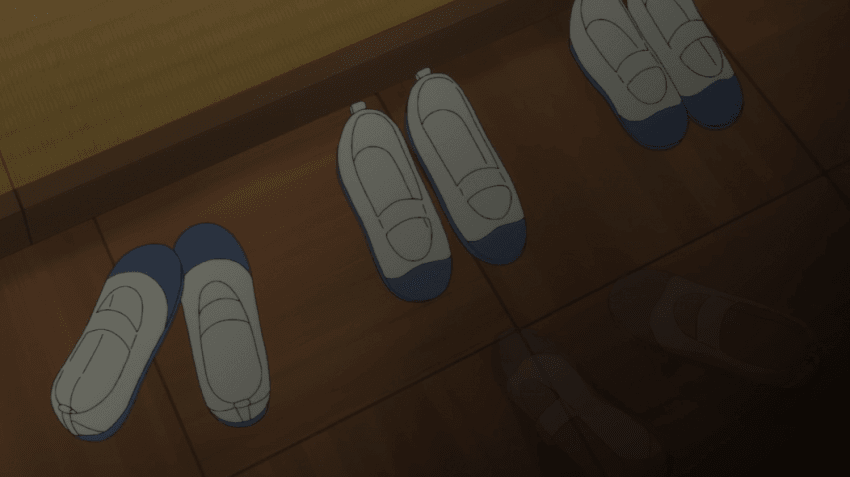
《mono》, episode 12.
The camera of 《mono》 is ambivalent. Four pairs of indoor shoes placed in the cinephoto clubroom; the cinephoto club calls Tajima-san, a ghost member with long orange hair and a my-pace personality, and ambitiously decides to shoot a POV horror, horror mockumentary film. Three pairs of indoor shoes placed in the cinephoto clubroom; Tajima-san had gone home first, though. On Fukashiro Dam, the sequence of scenes in which they shoot a film begins from a film-shooting “documentary” accompanied by the narration of Satsuki and the others, excluding Tajima-san. This documentary soon becomes a “film” in front of the Dosojin model, and after Tajima-san, contrary to the agreement, runs toward the lake, a splashing sound is layered over a long shot showing Satsuki and An stunned, and it becomes a “documentary” again. “Sorry, I remembered something urgent, so I’ll go back to the bus like this.” But after that, the protagonists never saw Tajima-san at school. Tajima-san was a plain girl with short black hair. “Then who in the world was that person who shot a video with us….” $3+1/2$ pairs of indoor shoes placed in the cinephoto clubroom; the three living indoor shoes are juxtaposed with Tajima-san’s semitransparent, immaterial indoor shoes. Double exposure. “The ghost member Tajima-san whom we knew really vanished suddenly, as if she were a ghost.” Yet this commotion was a hidden-camera prank set up by Sakurako and Inomata, an alumna of the film research club who played Tajima-san (fake), and at the same time as this confession, all those scenes became “film” again. In the end, was the video shot by the protagonists film or documentary? Probably choosing one of those two as the correct answer would be like saying light is either a particle or a wave. This question may not have any meaning: Ozu’s films and 《Tokyo-Ga》 have taught us that film and documentary each contain the properties of the other. Therefore, we must suspend the task of answering this question. Or call that image cinephoto.
《mono》 as Cinephoto
What pierces through that cinephoto and exposes fiction is Sakurako’s contradictory description of Tajima-san. There is something like that in 《mono》 as documentary as well. It is sakuga.
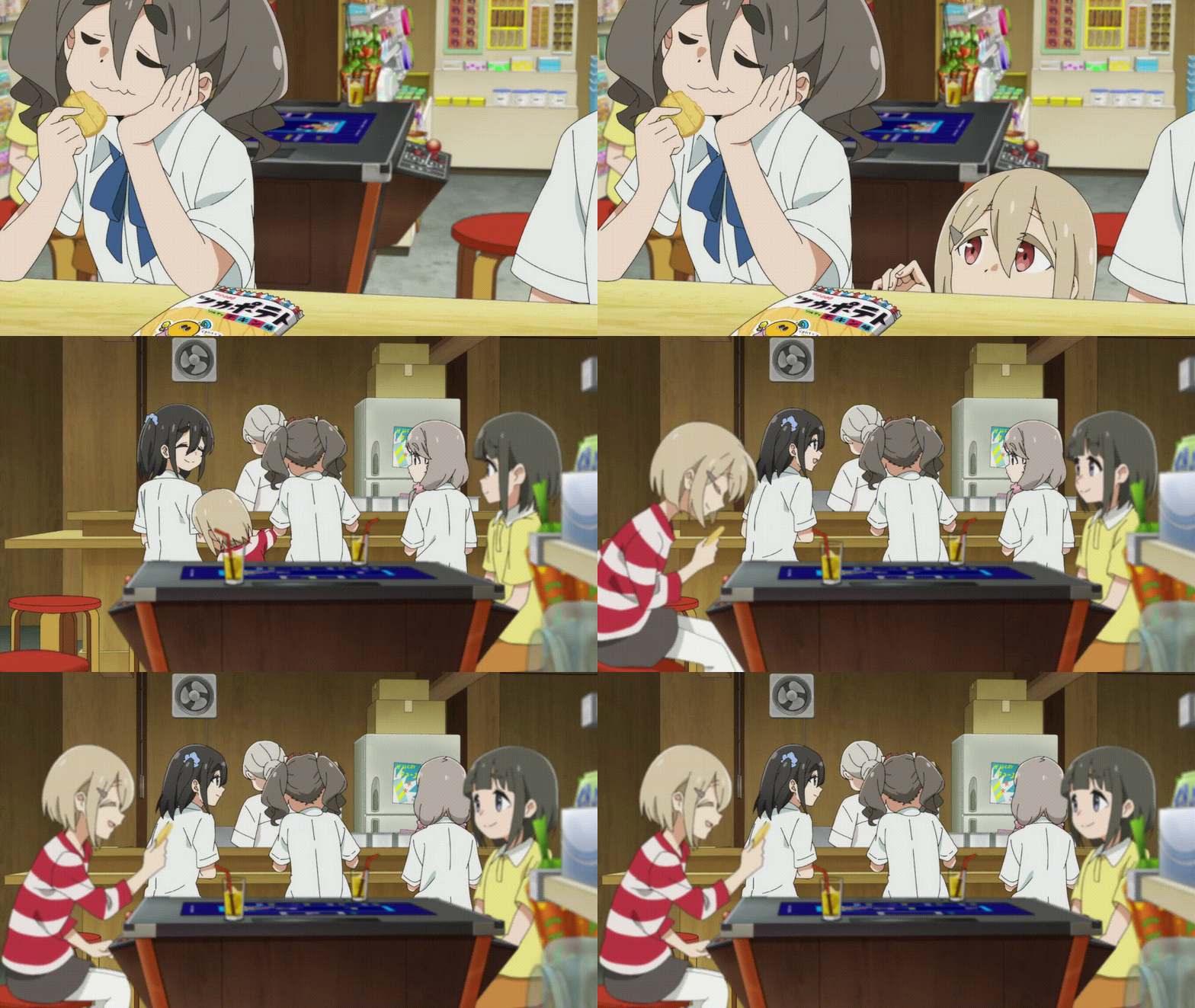
《mono》, episode 3.
One medium that mediates the documentary truthfulness of 《mono》 is sakuga. For example: in two consecutive shots of episode 3, a mischievous child stealing sweets in a direction that pierces behind the protagonists as they discuss what photos to take at Haruno’s old candy shop. The action camera overtaking its subject, An riding a skateboard, or showing the bushes and asphalt. The swaying trees passing behind Satsuki and the others as they film in 360 degrees while riding the panorama lift. The mirage in which the movements of the protagonists walking the Yamanashi shaved-ice pilgrimage route are reflected. These sakuga look like the moments of truth that Wim Wenders found in Ozu’s films. Of course. The human eye rather sees motion, and each shot of animation contains little motion. For that reason, these are the protagonists of their own shots. Their movements are triggers that set off memories of the periphery that had been outside the center of vision, and perhaps they cannot be as truthful as those memories.
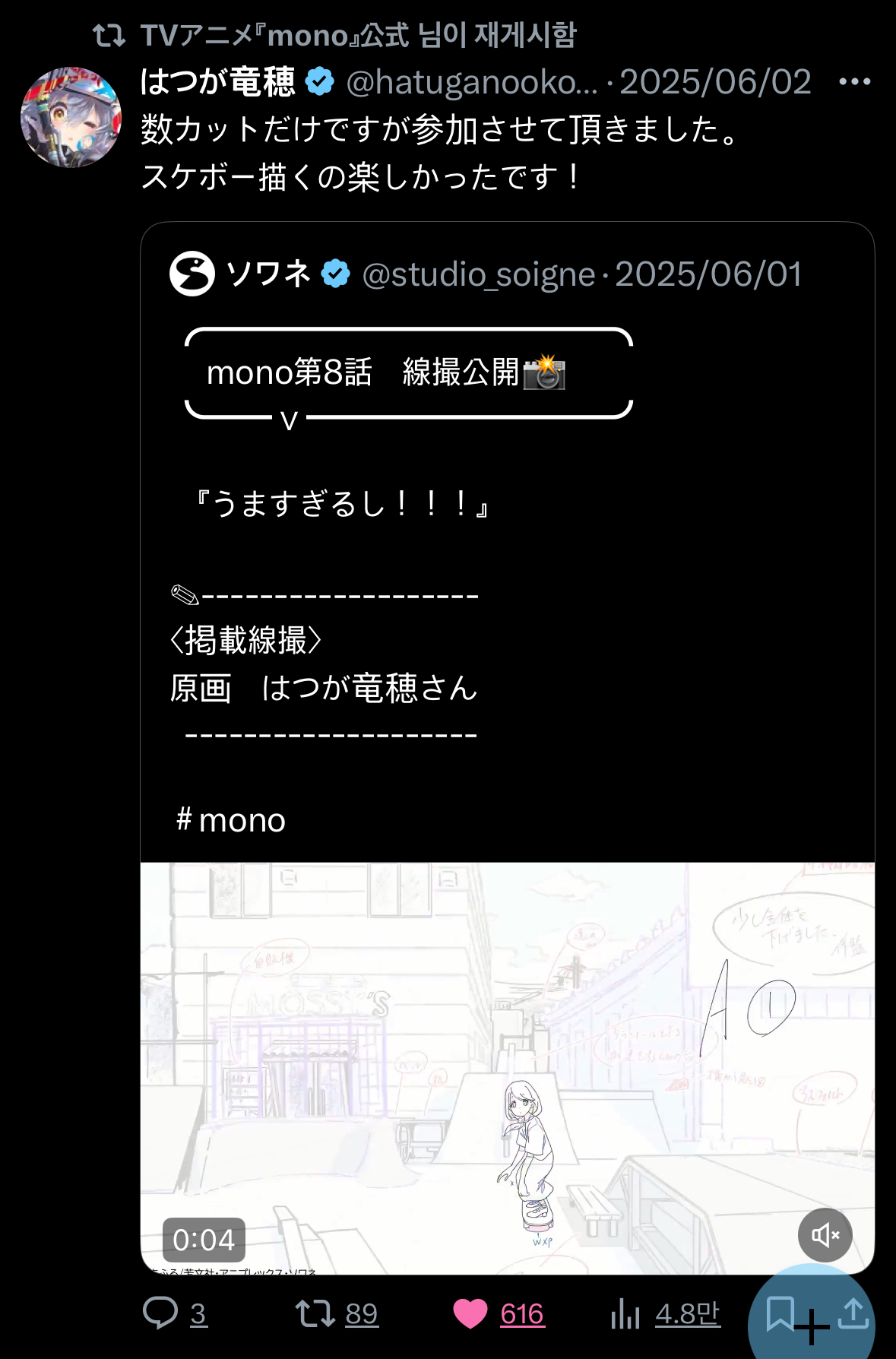
X, @mono_weekend.
On the other hand, the sakuga of 《mono》 is auteurist. 《mono》 is within the current of nichijou-kei sakuga anime. Everyone can sense this naturally, partly because of the official X account of 《mono》. The point is that when we scroll through the official X account of 《mono》, we encounter reposts of impressions and celebratory illustrations posted by people involved in production, and above all, the key animation posted by Soigne and the names of the animators who drew that key animation2. Key animation, as the blueprint of movement or of animation, includes rough drawings colored in several symbolic colors and numbers indicating placement within a motion. In other words, in key animation we see symbols related to the outside of animation, to animation “production.” Also, because the outside of the screen is drawn in key animation, we feel that the images drawn in the key animation are the whole of that world. Outside the key animation, there is the name of the key animator. Between animation and its end, there are ending credits. On the cover of the manga 《mono》 there is the name of Afro. Right here, it is exposed that 《mono》 was created by someone. The sakuga of 《mono》 now weakens the documentary force of 《mono》 between the animation and its end. It opens a hole in the documentary. By revealing the name of Takahashi Yuichi instead of An riding a skateboard and the periphery around her.
Therefore, we should call 《mono》 cinephoto.
The Ghosts of 《mono》
In a different context, another factor that makes 《mono》 cinephoto is ghosts. This sentence sounds like a tautology….
There are three ghosts in the anime 《mono》: (1) the ghost of a girl who attached herself to Haruno at Yashajin Pass, (2) Kurokuma’s assistant, and (3) Kurokuma encountered in front of the single pine tree of Nanamagari. The rest are illusions seen by the protagonists. Yet viewers find them boring above all because these ghosts were shot like Tajima-san’s indoor shoes, by double exposure. That is, whether the ghosts “really” exist or not does not affect the protagonists’ route. For example, the protagonists see the ghost of the girl only in the video, but even if the ghost does not exist, something that “looks like” a ghost might appear in some video. This double exposure means that 《mono》 has been somewhat adapted by Haruno. And this is exactly the method of making spirit photographs. 《mono》 is a spirit photograph, and the spirit photograph is already cinephoto.
《mono》 as documentary is a spirit photograph that is only animation. Spirit photographs are certainly uncanny, but before that, photographs themselves are already uncanny. As Yoo Woon-sung writes in The Temptation of the Vegetal, following Roland Barthes, “the more a person in a photograph functionally clings to factuality, as in press photography, the more, the more one looks, they seem to hide all kinds of stories; and the more a person in a photograph functionally clings to fictionality, as in advertising photography, the more defenselessly they expose to the viewer the factual features attached to their face and body.” Spirit photography merely brings that uncanniness to the center. This is in order willingly to give up strong indexicality while giving, through uncanniness, the “impression” that it presents indexical evidence of ghosts. For what purpose did 《mono》 become a spirit photograph? Or, conversely, should ghosts have been removed from 《mono》?
I hastily called the ghosts of 《mono》 double exposure, but in fact there is a profound difference between double-exposed images and the ghosts of 《mono》: these ghosts are opaque. Or, the author of 《mono》 draws ghosts as real beings with bodies. Put differently, the protagonists and the ghosts are placed on the same ontological level.
As in viewers’ lukewarm reaction to ghosts, modern people who seriously believe that ghosts exist are an endangered species. In the same context, are there really otaku who seriously believe that the protagonists of 《mono》 and 《Yuru Camp△》 live in Yamanashi? But even while not believing in their existence, otaku follow their routes as if they had been there. Otaku envy those who have successfully reproduced and recorded their routes, giving them upvotes and front-page recommendations. But is this not precisely ― ideology, there are many names, but above all ― a ghost?
《mono》 seems to go one step further here. 《mono》 itself truly manifests its protagonists here as ghosts. The self-reference that makes the protagonists ― at least their models ― be here, and the ending credits (ⓒあfろ/芳文社・アニプレックス・ソワネ), contradict each other, so neither can be believed unconditionally. In short, we discover the protagonists inside 《mono》 as documentary, just as Satsuki and An discover the ghost attached to Haruno inside the action-camera footage. This is also why the protagonists of 《Yuru Camp△》 were inserted subliminally, and why 《mono》 presented itself as a spirit photograph. For those who will go to meet their ghosts, 《mono》 played the prank of releasing ghosts into Yamanashi.
The girl ghost attached herself to Haruno because she “was happy, since Haruno looked like the bird she had kept when she was alive.” In order to remove her, Haruno, following Kurokuma’s advice, rides a bus through the tunnel of Yashajin Pass and recites in her heart, “You must have been lonely in the mountains; I will come visit from time to time, so this time please….” Haruno passing through the tunnel, “See you again,” and a sequence of bird’s-eye shots in which the viewpoint rises and shows the bus growing smaller and smaller. As if she had attained Buddhahood…. A small but profound, playful reversal: on the way back, as soon as Haruno passes through the tunnel again with a light heart, that ghost is attached to her again. If Haruno passes through the tunnel again, she will attach herself again at any time. The ghosts of 《mono》 as well.
A Documentary of “Nichijou-kei,” Notes Toward Meta-Nichijou-kei
I declared too hastily above that 《mono》 is a documentary, but we must not stop here. More strongly than that obvious fact, if 《mono》 is a documentary, we must ask what kind of documentary it is.
Various theories of photography, including Susan Sontag’s writing that photography is “shot through with pathos” (Susan Sontag, 1977/2005), emphasize that photography is a sign of absence. The beginning of 《mono》, Satsuki feeling lonely at the graduation of senior Makinohara, and episode 2, Sakurako recalling the film research club seniors who have left while watching Satsuki and An discuss how to take better aerial footage, seem to respond to this. As with 《Tamayura》, it cannot be denied that 《mono》 begins from the loneliness of absence. Yet unlike 《Tamayura》, senior Makinohara’s absence is not explicitly shown after the first two episodes until before the final episode. Senior Makinohara appears only briefly, in episode 3, as the lock screen when Satsuki checks the time on her phone, inserted among ordinary shots. 《mono》 is not photography, and above all it is animation that merely includes the taking of photographs. In short, except for the first and final episodes, the photography of 《mono》 is photo-“taking,” and therefore present tense. What viewers see is not photographs, but rather the images projected onto the camera at the very moment of taking photographs.
The photographs of 《mono》 are past tense only in the final scene where Satsuki reunites with senior Makinohara. But this reunion is not a return to the time before senior Makinohara’s graduation, to the first scene. Satsuki’s words following the photographs shared with senior Makinohara: “(…) I’m taking lots and lots of photos and videos. So I’m, right now, having so much fun!” The image that accompanies this is not a photograph recalling past events, but a moving image forming in Satsuki’s camera as she is about to shoot in 360 degrees. “I want to film all kinds of things!” The tense of 《mono》 is present. This is all the more so in that even while Satsuki looks at past photographs, instead of feeling pathos, she merely speaks of the state represented in those photographs that continues up to the present. Even if 《mono》 began from the loneliness of absence, it ends with the joy of existence ― which every nichijou-kei seems to want to depict. Therefore, let us call 《mono》 a documentary of nichijou-kei. This tense-based double structure of nichijou-kei and documentary resonates with the axis of 《mono》 as cinephoto=ghost.
As Hirose Masahiro pointed out in “The Prison Called ‘Kuuki-kei’: The Anime 《K-On!》 and the Imagination Surrounding Sex” (2013), while insisting that 《K-On!》 is not “kuuki-kei,” nichijou-kei is not something like a “paradise” of girls from which conflict and time have been castrated. Rather, nichijou-kei is an attempt to draw a new form of growth. This growth is not the conventional shōnen-manga-like declaration of having escaped / intending to escape from moratorium ― an extremely Japanese word ― but a microscopic advancement secretly hidden inside memories and experiences, or loves and friendships, that are merged under the single word everyday, with its enormous extension, but in fact cannot be reduced to anything. In 《Tamayura》: “Within unchanging days, something changes little by little. The time that has passed cannot be turned back, but precisely because of that it is precious and I do not want to forget it, so I keep it in my chest as memories.” Thanks to this, when one looks back at the protagonists as they were in the first episode from the final episode, even though their awakening or rite of passage has not been made visible and drawn through major conflict, one can sense a feeling of growth. Perhaps this automaton, which makes one look again at the past lying at the end after passing through countless episodes one cannot remember, is what produces the strange nostalgia felt in nichijou-kei. But this distinctive mode of storytelling also produces the structure of a closed circle that, after seeing the final episode, makes the otaku head back to the first episode and makes it hard to escape. Thanks to this, nichijou-kei has received much criticism ― including the stigma of timelessness.
But meta-stories that explicitly block the phenomenon of “running the fixed route again” allow us to imagine beyond it. The friends of the 82nd Student Council in the final part of 《Gakuen Utopia Manabi Straight!》 who stop and encourage Mikan as she tries to return to the romantic Seioh Academy, 《Revue Starlight》 which cuts off the closed repetition of the 99th Starlight produced by Nana, and so on. And now, 《mono》 as well. What, in the end, did 《mono》 leave behind? Pranks and ghosts, a will not to return to loneliness, and, in a certain sense, small arts of the everyday that may be called microscopic resistance ― to be transmitted through sacred-site pilgrimage.
Like Satsuki, who set senior Makinohara’s photograph as the lock screen of her phone, we will keep 《mono》 as the wallpaper of our phones; we will also wander around Yamanashi along their routes in order to find the ghosts of 《mono》, and trade secondhand goods to pull SSR Haruno. But just as 《mono》 did, we will not return to the loneliness of the first episode. Just as Satsuki happened to meet senior Makinohara again beyond the screen, we will someday happen to meet 《mono》 again. And following 《mono》, which is meta only in the most yuru way, we will say this: “After senpai graduated, I did feel down, but Kiriyama was there, and after I bought a new camera I met Haru-san too, and then we merged with Sakurako’s film club and became the cinephoto club. I also got to know Haru-san’s friends and colleagues in the industry. I even became a model for the manga Haru-san drew, and I’m taking lots and lots of photos and videos. So I’m, right now, having so much fun!”
-
These direct images of time are not special, but general images of nichijou-kei anime. For example, the fifty-second close-up in episode 4 of 《Non Non Biyori》 that silently shows Renge’s face after her hair has turned white. ↩
-
Like Kutsuna Kenichi’s classification somewhere of sakuga-ota, sakuga-otaku, and sakuga-mania, the phenomenon of sakuga-ota would not have been possible without SNS. ↩